MailerLite review for Australian small businesses
We tested MailerLite with a fictional Australian small-business scenario to see how it handled the practical jobs behind an email program: importing subscribers, organising a list, building and personalising an email, collecting a signup with double opt-in, creating an automation and reviewing local billing.
Most of those tasks worked as expected. The important qualifications are that we sent only one controlled message to an inbox we own, did not activate the automation and did not buy a paid subscription. Our findings describe what happened in that controlled account, not every possible MailerLite setup.
Quick verdict
MailerLite successfully handled most of the core email-marketing tasks we tested. Importing contacts, using groups, creating an email without manual HTML, first-name personalisation, controlled delivery and double opt-in all worked. Its automation builder also let us construct a sensible welcome sequence, although we did not activate it.
The main cautions for an Australian business are foreign-currency billing, a Free tier limited to 250 active subscribers in our account, and one State-based segmentation rule that did not behave as expected. MailerLite is worth investigating when the priority is focused email marketing rather than a broader CRM and marketing suite.
Who is MailerLite suited to?
Based on the workflows we tested, MailerLite is most relevant to small businesses that need newsletters, signup forms, subscriber organisation and straightforward automated follow-up. That could include a local service business, consultant, online retailer or community organisation managing a modest email list.
Businesses that need deep lead scoring, sales pipelines or complex cross-channel automation may want to compare a broader platform. Our email marketing guide for Australian small businesses explains the wider selection criteria.
Ease of use
The main subscriber, campaign, form and automation areas were understandable during our test. We could create a realistic email without editing HTML, and the path from a group trigger to a multi-step welcome sequence was clear enough to follow.
Contact import had a learning curve. Field mapping took some attention, and the Add new field control was easy to overlook lower in the selector. Once we understood that screen, the import process became straightforward. We view this as a setup learning curve rather than a major product defect.
Subscriber import and management
Our fictional Australian SME contact data imported successfully. We were able to preserve custom information, which matters for a business moving from a spreadsheet or another email platform rather than starting with an empty list.
Useful fields can include state, suburb, customer type, service interest and company information. A business should still check its mapping carefully before importing a real database, particularly where custom fields will later drive targeting or automation.
Groups and segmentation
We successfully placed 12 fictional subscribers into a test group. Groups were straightforward to use and could also act as an automation trigger. Practical group examples include customers, prospects, newsletter subscribers, lead-magnet signups, event attendees and interest categories.
One segmentation test produced a less satisfactory result. We tried a custom rule where State = NSW. Relevant subscriber records visibly contained NSW, but the rule repeatedly reported the value as missing.
This does not establish that MailerLite segmentation generally fails. It means that one specific custom-field segmentation scenario did not behave as expected in our test account. Groups remained a workable way to organise the contacts we tested.
Email builder and personalisation
We built a realistic SME email without writing manual HTML. The editor was suitable for the layout and content needed in our controlled workflow, and first-name personalisation worked.
During setup, our greeting appeared as HelloDaniel. We had placed the personalisation variable immediately beside “Hello” without a space. This was a SMEScout configuration error, not a MailerLite defect, and is a useful reminder to preview personalised copy before sending.
Did the test email arrive?
Yes. Sender verification succeeded, and one controlled test email arrived in a tester-owned inbox with the expected content. That confirmed the basic send path for the scenario we tested.
One controlled test message is not a deliverability benchmark.
We did not test a genuine campaign audience, multiple mailbox providers, large-volume sending or long-term inbox placement, so we do not draw broader deliverability conclusions from that single arrival.
Forms and double opt-in
The embedded signup form completed a real double-opt-in sequence in our controlled test. We submitted the form, received the confirmation email, clicked its confirmation link and reached the success page.
This verified the mechanics of that workflow in our account. It is not a legal or compliance guarantee; businesses remain responsible for configuring forms, consent language and record-keeping appropriately.
Automation
We built a workflow with a group-membership trigger, welcome email, one-day delay and follow-up email. The builder supported that practical sequence without requiring custom code.
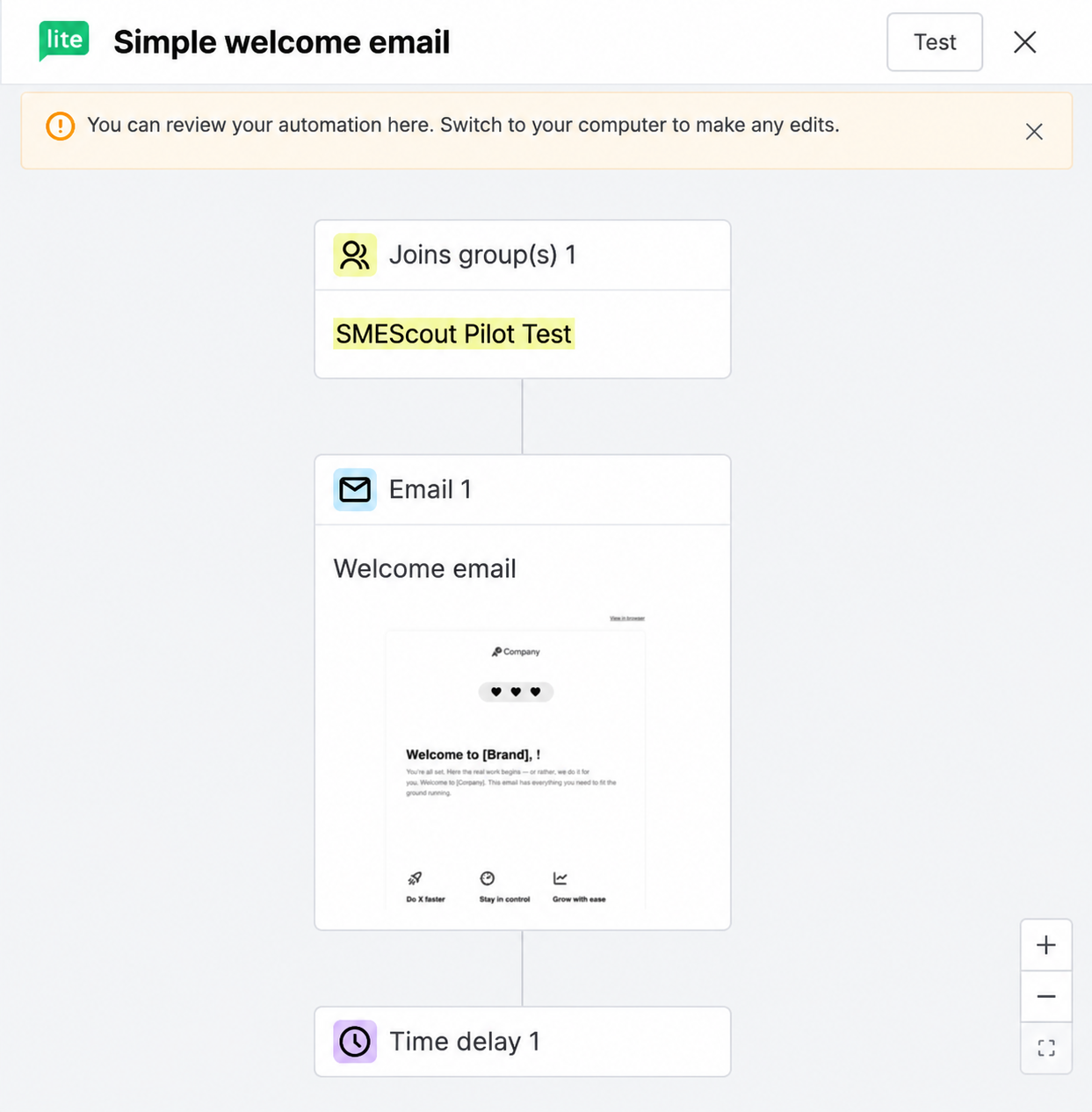
Builder functionality is therefore verified, but live automation execution is not. We did not test whether the messages would send at the intended times or how the workflow would perform with genuine subscribers.
Reporting
We inspected MailerLite's reporting areas, but we did not broadcast a campaign to genuine subscribers. There was no meaningful audience data from which to assess open rates, click rates or reporting performance, so we do not make a reporting-quality judgement here.
MailerLite pricing for Australian businesses
The following prices were visible for up to 500 subscribers during our September 2026 test.
We rechecked the account on 3 October 2026. The same plan names, Free limits, prices at this subscriber tier, 10% annual discount and USD/EUR currency options were still shown; we still did not see an AUD billing option.
| Plan | Tested price at up to 500 subscribers |
|---|---|
| Free | US$0 |
| Comfort | US$12/month |
| Power | US$25/month |
| Enterprise | Custom |
The Free plan showed 250 active subscribers and 2,500 emails per month. Annual billing displayed a 10% discount. For contact-tier details and the checkout evidence, see our full MailerLite pricing analysis.
Check current MailerLite pricing
Is MailerLite priced in AUD?
No AUD billing option was visible in our Australian account. We saw USD and EUR. For an Australian business, the final dollar amount can therefore depend on the exchange rate, the card issuer's conversion method and any foreign-transaction fee.
We do not publish a fixed AUD conversion because those inputs can change.
Does MailerLite charge GST in Australia?
MailerLite added 10% GST in the Australian checkouts we tested. Monthly Comfort showed US$12.00 for the plan, US$1.20 GST and US$13.20 due.
Annual Comfort showed a US$144.00 base price, a US$14.40 discount, a US$129.60 taxable subtotal, US$12.96 GST and US$142.56 due. The observed order was discount first, then GST.
The checkout also showed Australia as the billing country, a company billing option and an Add my VAT/Tax ID option. We do not assume that entering an ABN removes GST. Businesses should rely on the tax and final payable amount shown for their own billing details.
Free vs Comfort vs Power
Free
Free is most relevant for evaluation, an early-stage project or a genuinely small list. The 250-active-subscriber limit visible in our test leaves little room for an established business to grow before considering a paid tier.
Comfort
Comfort is the paid tier we would investigate first for many established SMEs whose needs centre on newsletters, forms, subscriber groups, standard personalisation and straightforward automation. That is a starting point for comparison, not a universal plan recommendation.
Power
Power is worth considering only when its additional sending capacity, automation or account capability, user access or support capability solves a real business need. The detailed plan comparison belongs in our pricing guide.
MailerLite pros and cons
Pros
- Subscriber import worked.
- Groups were straightforward.
- The controlled test email arrived.
- Double opt-in worked end to end.
- A practical automation structure could be built.
- Australian GST was clearly itemised.
- A free entry tier was available.
Cons
- No AUD billing option was visible.
- Free was limited to 250 active subscribers in our test.
- One custom State segment did not work as expected.
- Live automation execution was not tested.
- Some setup controls were initially easy to overlook.
- Currency conversion may affect the final AUD cost.
MailerLite vs ActiveCampaign
MailerLite felt more focused on the core email workflow we tested: subscribers, campaigns, forms, groups and moderate automation. ActiveCampaign exposed significantly deeper automation in our testing, alongside broader CRM-oriented capability and greater complexity.
There is no universal winner. A business mainly sending newsletters and building straightforward follow-up may prefer the narrower MailerLite approach; a team with genuinely complex automation requirements should also read our ActiveCampaign review Australia.
What we could not verify
Our test did not verify:
- live automation execution or message timing;
- large-scale sending or broad inbox deliverability;
- support response quality or long-term reliability;
- reporting against a genuine campaign audience;
- performance with thousands of real subscribers;
- every available integration; or
- Enterprise functionality.
Is MailerLite good for Australian small businesses?
It can be a credible option for an Australian SME whose needs are centred on email. The tested workflow covered subscriber import, organisation, email production, personalisation, a controlled send, double opt-in and an automation draft without requiring a broader sales CRM.
The fit is less clear if the business needs sophisticated sales processes, deep automation or AUD billing. The low Free subscriber ceiling also means a growing list may reach paid-plan territory quickly.
SMEScout verdict
MailerLite successfully handled most of the practical email-marketing jobs we tested: import, organisation, email creation, personalisation, controlled delivery, double opt-in and building a welcome automation.
Its main limitations in our test were foreign-currency billing, the Free tier's low active-subscriber ceiling, the unresolved State-based segment scenario and the fact that live automation execution remains unverified.
It is worth investigating for Australian SMEs that need focused email marketing rather than a broader CRM and marketing suite. Review our MailerLite Pricing Australia guide for the detailed cost evidence before choosing a plan. Browse our email marketing software guidance for the other tested options and buying considerations.
Frequently asked questions
Is MailerLite good for Australian small businesses?
It is worth considering for SMEs focused on newsletters, signup forms, subscriber organisation and straightforward automation. Businesses needing deep CRM workflows may require a broader platform.
Did SMEScout actually test MailerLite?
Yes. We tested contact import, groups, one custom-field segment, email creation and personalisation, a controlled send, an embedded form, double opt-in, an automation draft and Australian billing. We did not buy a subscription.
Is MailerLite priced in AUD?
No AUD option was visible in our Australian account; USD and EUR were available.
Does MailerLite charge GST in Australia?
Our tested Australian monthly and annual Comfort checkouts both added 10% GST.
Does MailerLite have a free plan?
Yes. In our test it allowed 250 active subscribers and 2,500 emails per month.
Which MailerLite plan should an Australian small business consider?
Free suits evaluation or a very small list. Comfort is the paid tier we would investigate first for many established email-focused SMEs; Power needs a specific requirement that justifies its additional capability.
Does MailerLite support double opt-in?
Yes. Our controlled embedded-form double-opt-in sequence completed end to end.
Does MailerLite support automation?
We built a group-triggered welcome workflow with two emails and a delay. We did not activate it, so live execution and timing remain unverified.
Did MailerLite segmentation work in your test?
Groups worked. One specific custom-field rule for State = NSW did not behave as expected, which does not establish that MailerLite segmentation generally fails.
MailerLite or ActiveCampaign: which should I choose?
MailerLite is more focused on core email workflows; ActiveCampaign exposed much deeper automation in our testing. Choose according to the complexity your business actually needs.