Our short verdict: ActiveCampaign is worth considering for an Australian small business that needs segmented campaigns and multi-step workflows. Our import, segment and double-opt-in checks worked, and the automation builder exposed considerable flexibility. If you mainly send straightforward newsletters or need to manage contacts from a phone browser, a simpler platform may be a better fit.
What we tested
- Tested: contact import, an NSW segment, personalisation, one controlled email delivery and the complete double-opt-in flow.
- Observed or inspected: an inactive automation draft, reporting screens without broadcast data, integration listings, checkout and mobile-browser Contacts.
- Vendor documented: current plan entitlements and trial limits, checked separately on 5 October 2026. These are not new hands-on results.
ActiveCampaign's documented trial provides Professional-level functionality for 14 days, with 100 contacts and 100 sends. A feature visible in our trial should not be assumed to belong to Starter.
Contact import
We imported 12 fictional contacts. ActiveCampaign recorded 12 successful, 0 partial and 0 failed. We also created custom fields for Company, State, Suburb, Service Interest and Customer Type during the import.
The main issue was an initial Company-to-Account mapping suggestion, which we corrected before completing the import.
Segmentation
We created SMEScout ActiveCampaign NSW Leads with the condition State is NSW. The source data contained six NSW contacts and ActiveCampaign returned six active contacts and six total contacts.
Email builder and personalisation
The drag-and-drop editor included text, image, button, video, social, menu, banner, timer, HTML, RSS and other blocks. Desktop and mobile previews were available.
We inserted a first-name personalisation field. Without a sample contact selected, the preview rendered Hello ,. With our tester contact selected, it correctly rendered Hello Dan,.
We also sent one controlled test email to an inbox we own. It arrived with the expected subject, campaign content, unsubscribe link and fictional Harbour Lane footer.
One successful test delivery is not a deliverability benchmark, so we do not extrapolate it to large lists or other mailbox providers.
Forms and double opt-in
We created an inline signup form with Full Name and Email fields. ActiveCampaign also exposed CAPTCHA, phone, list controls and the custom fields created earlier.
Opt-in Confirmation was enabled. We submitted our tester-owned address, received the confirmation email, clicked the confirmation button and reached the post-confirmation page.
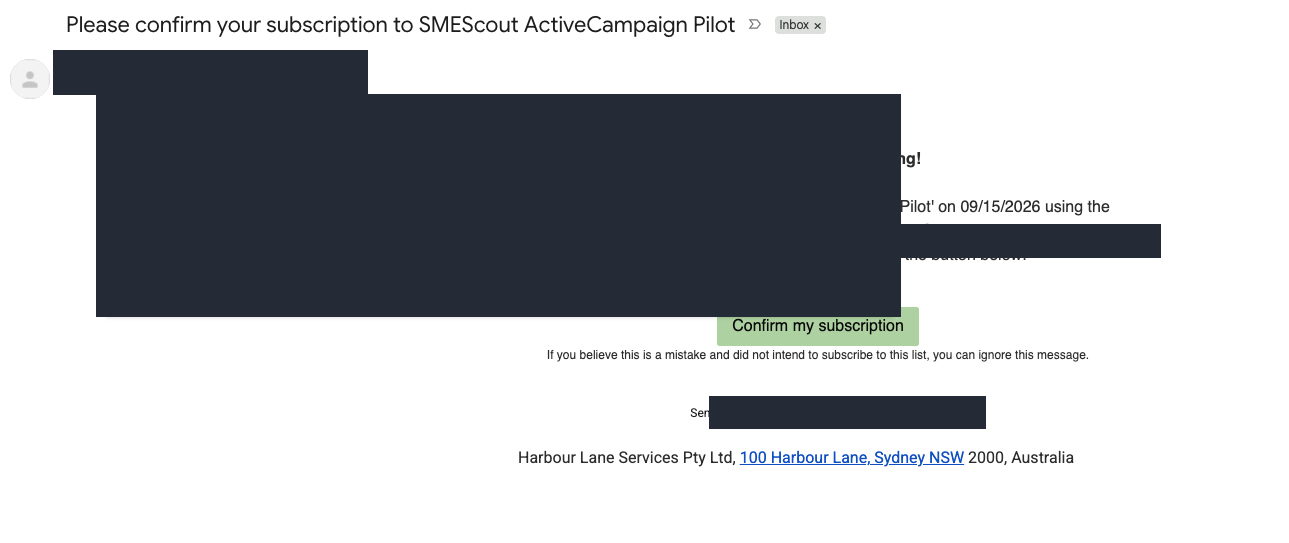
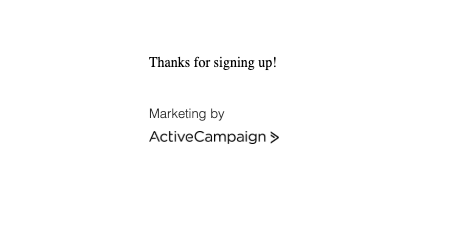
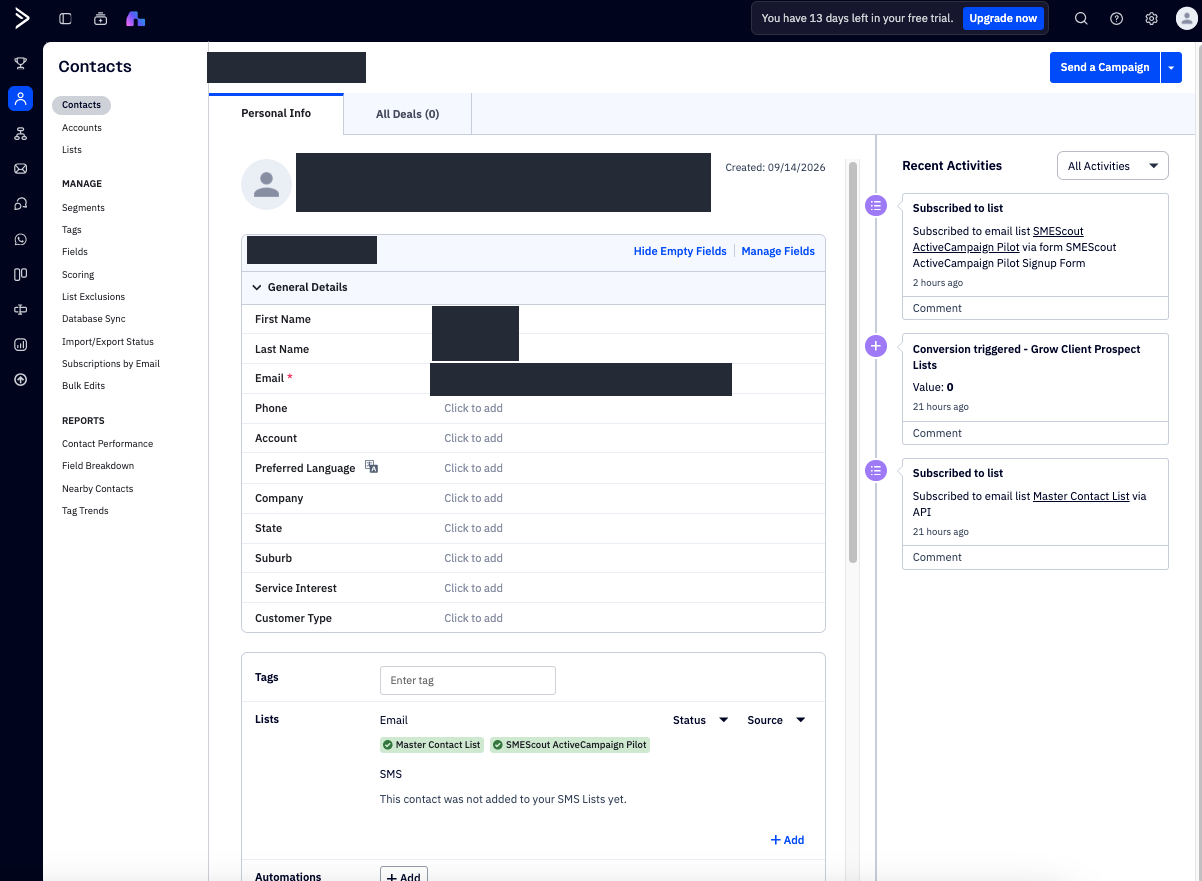
The final contact screen did not literally display the words Active or Confirmed, so we do not claim those exact UI labels. The end-to-end confirmation flow did complete successfully.
Automation
We built a welcome automation with a subscription trigger, welcome email, one-day wait, follow-up email and end step. We deliberately kept it inactive.
The builder exposed triggers and actions across lists, tags, fields, email engagement, CRM and deals, ecommerce, page visits, scoring, tasks and apps.
Starter displayed a limit of five actions per automation. Plus, Pro and Enterprise showed unlimited automation actions during our test. The builder was the strongest capability we inspected, but building this draft did not verify execution, timing or reliability in a live customer journey.
Reporting
Reporting screens exposed sends, open rate, click rate, click-to-open rate, bounces, unsubscribes and revenue. Because we did not broadcast the campaign, the account contained genuine zero send data.
We inspected the reporting interface but did not treat advanced reporting performance as independently verified.
Integrations for Australian SMEs
ActiveCampaign has a broad integration ecosystem. During our September research, Xero had a named middleware integration powered by Zapier. Microsoft Dynamics 365 also had documented bidirectional support, with the marketplace listing we reviewed placing it on Enterprise.
We did not connect an integration. Our marketplace searches did not produce a clear named Canva listing, and the visible MYOB results did not show a named MYOB integration. That does not rule out connection through Zapier, Make or another intermediary.
Mobile browser usability
This was one of the weakest parts of our test.
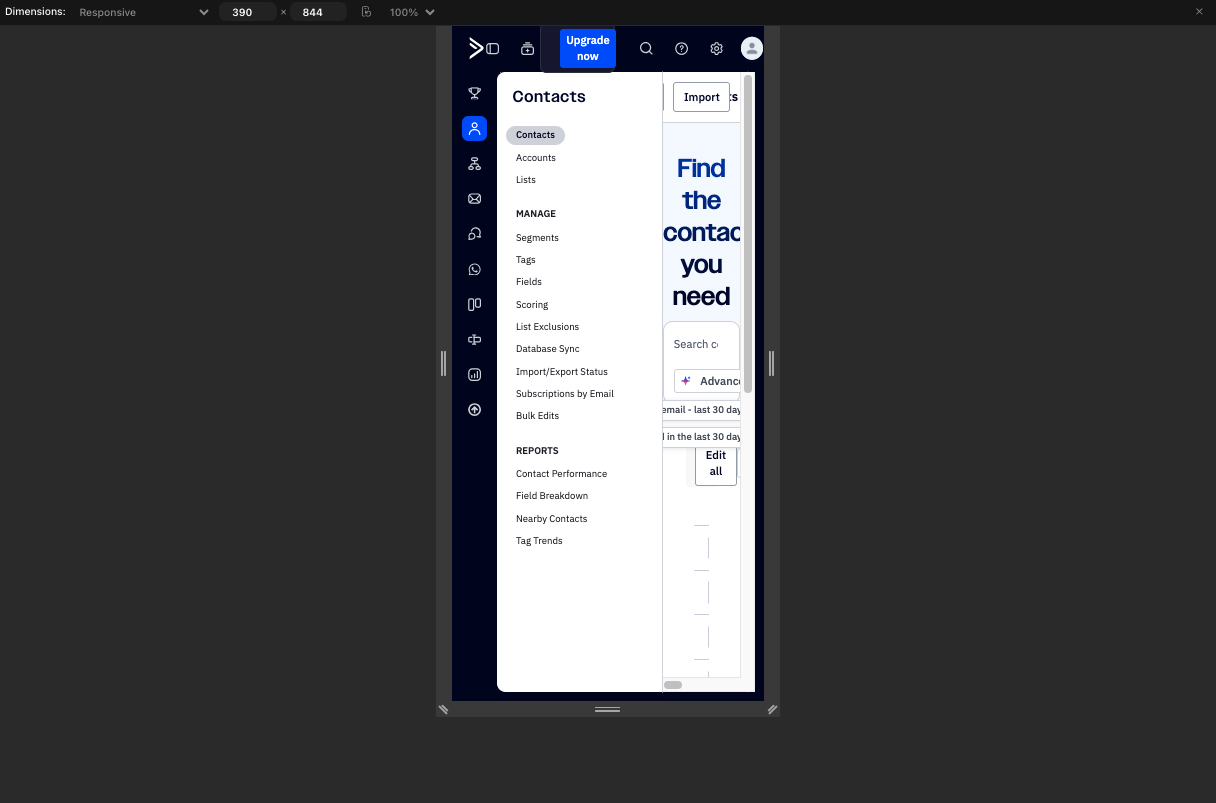
At a controlled 390 × 844 browser viewport, the Contacts interface adapted poorly. The navigation consumed a large portion of the width, content became squeezed, columns were clipped and horizontal scrolling was required.
Strengths and limitations from our test
What worked well
- Contact organisation: the import and NSW segment matched our small fictional dataset, with custom fields available during import.
- Campaign preparation: the editor offered varied blocks and previews, and personalisation worked with the tester contact selected.
- Signup confirmation: the form-to-email-to-confirmation flow completed end to end.
- Workflow design: we could build a multi-step welcome sequence and inspect a broad range of triggers and actions.
Where we would be cautious
- Setup needs attention: the suggested Company mapping needed correction, and personalisation required a sample contact to preview properly.
- Mobile web: Contacts was cramped and clipped at the tested phone-browser size.
- Budget complexity: contact growth, plan gates, extra seats and commitment terms matter beyond the entry price.
- Evidence limits: one test email is not a deliverability study; an inactive automation and empty reports cannot establish live performance.
Who ActiveCampaign suits
It is worth investigating when your business needs to organise contacts using meaningful fields and segments, personalise campaigns and design multi-step follow-up. Those are concrete tasks we could set up in the trial. Have someone responsible for checking mappings, preview data and workflow logic rather than treating automation as a set-and-forget shortcut.
Who should consider something simpler
A business mainly sending a newsletter with a short welcome sequence may not need this depth. A team expecting to work primarily from a phone browser should also examine the Contacts workflow carefully. For a lower-complexity alternative, see our hands-on MailerLite review. Our email marketing software hub brings the tested reviews and pricing guides together when you are comparing options. That is an alternative to investigate, not a claim that one platform is best for every SME.
ActiveCampaign pricing in Australia
At 1,000 contacts, September's tested annual-billing monthly equivalents ranged from A$23 for Starter to A$218 for Enterprise. The public AUD selector matched these on 5 October 2026. These are not flexible month-to-month prices, and GST inclusion remains unresolved. See ActiveCampaign pricing Australia for the contact-tier table, included seats, additional costs and dated checkout evidence.
The buying question is whether the capabilities your team will actually use justify the cost as your database grows. Our historical checkout also offered an annual commitment paid in monthly instalments; paying monthly did not make that arrangement flexible month-to-month billing.
GST and Australian checkout
We could not establish final GST treatment from September's pre-payment screen. No GST line, ABN/Tax ID field or included/excluded statement was visible. We did not purchase a plan, so this does not establish that GST is absent. The Australian checkout evidence is in the pricing guide; confirm the final tax treatment before subscribing.
Which ActiveCampaign plan should an Australian SME choose?
In our fictional two-marketer scenario, Pro's three included users, advanced segmentation and unlimited automation actions made it the most suitable tested functional fit. That does not mean every two-person business needs Pro. The official plan overview confirms paid additional users, including one extra on Starter and extra seats on Plus. We have not verified those current AUD seat prices.
Choose around the workflow, not just included seats: Starter's five-action limit may cover simple needs, while higher tiers remove that action cap but retain other feature gates. Ordinary contact management should not be confused with the separately priced enhanced sales-CRM add-ons available from Plus.
SMEScout verdict
ActiveCampaign's strongest observed capability was the depth of its automation builder, alongside the contact segmentation and campaign preparation we tested. We did not activate the automation, so this is an assessment of workflow setup, not proven execution reliability.
Its contact import matched our source data, our controlled test email arrived, and the double opt-in flow worked end to end.
The trade-offs are meaningful. Entry-plan limits matter, annual commitments need careful reading, Australian GST treatment was not clearly presented at the checkout stage we tested, and the mobile web Contacts experience was poor.
For an Australian SME that genuinely needs advanced automation, ActiveCampaign is a credible option. For a business mainly sending straightforward newsletters, a simpler platform may offer better value.
For broader selection criteria, read our email marketing guide for Australian small businesses and affiliate disclosure.
Frequently asked questions
Is ActiveCampaign a good choice for an Australian small business?
It may fit a business with a real need for segmentation and multi-step follow-up. Our controlled import, email and double-opt-in checks worked, but a business needing only basic newsletters should also evaluate a simpler option. We do not claim an overall category winner.
How steep is the learning curve?
Our test found practical checks to learn: correcting an import mapping, choosing sample data for personalisation and understanding automation actions. That supports allowing setup and review time, not a claim that every user needs a particular number of hours or weeks to learn it.
Did SMEScout verify that the automation ran reliably?
No. We built a welcome sequence but left it inactive. We can describe the builder and the draft we configured, not live execution or long-term reliability. One delivered test email is also not a deliverability benchmark.
When would a simpler platform be preferable?
If your main job is sending a straightforward newsletter and you do not need deeper segmentation or workflows, less complexity may be more useful than a longer feature list. Test the everyday tasks your team will actually perform before choosing.
Where can I compare Australian prices and plans?
Our ActiveCampaign pricing guide covers AUD annual-billing equivalents, contact tiers, plan limits and the unresolved GST finding. It separates September's account evidence from the public-pricing check on 5 October 2026.
Did SMEScout actually test ActiveCampaign?
Yes. We tested onboarding, import, segmentation, email building, a controlled test email, forms, double opt-in, pricing, Australian checkout and mobile web Contacts. We also built an inactive automation draft and inspected reporting screens without live broadcast data. No integrations or native mobile apps were tested.